English
 Vietnamese
 Italian
 Spanish
 Thai
 Japanese
 Portuguese
 Korean
 Russian
 French
 German
 Polish
 Indonesian
Automotive Inductor Traceability and Production Quality Requirements
Automotive inductors must satisfy two governing frameworks: IATF 16949 for traceability and process control, and AEC-Q200 for qualification of passive components. AEC-Q200 is the Automotive Electronics Council's specification for capacitors, resistors, inductors, transformers, crystals, and fuses; a part without it is not automotive-grade. IATF 16949 adds strict Automotive Inductor Traceability controls, Advanced Product Quality Planning, and formal risk management.
The stakes are absolute. Under-hood and safety-critical circuits demand zero failures across the vehicle's life, a standard commercial parts never face.
Parameter | Commercial ICs | Automotive requirements |
Operating temperature | 0°C to 85°C | -40°C to 150°C |
Expected operating life | 2–3 years | 10 years or more |
Acceptable failure rate | 300 parts per million | zero |
Counterfeit components are a real and well-documented risk in automotive supply chains. Procure all AEC-Q100- and AEC-Q200-qualified parts exclusively through franchised distributors that can provide full lot traceability back to the original semiconductor manufacturer.
Automotive Inductor Traceability Requirements
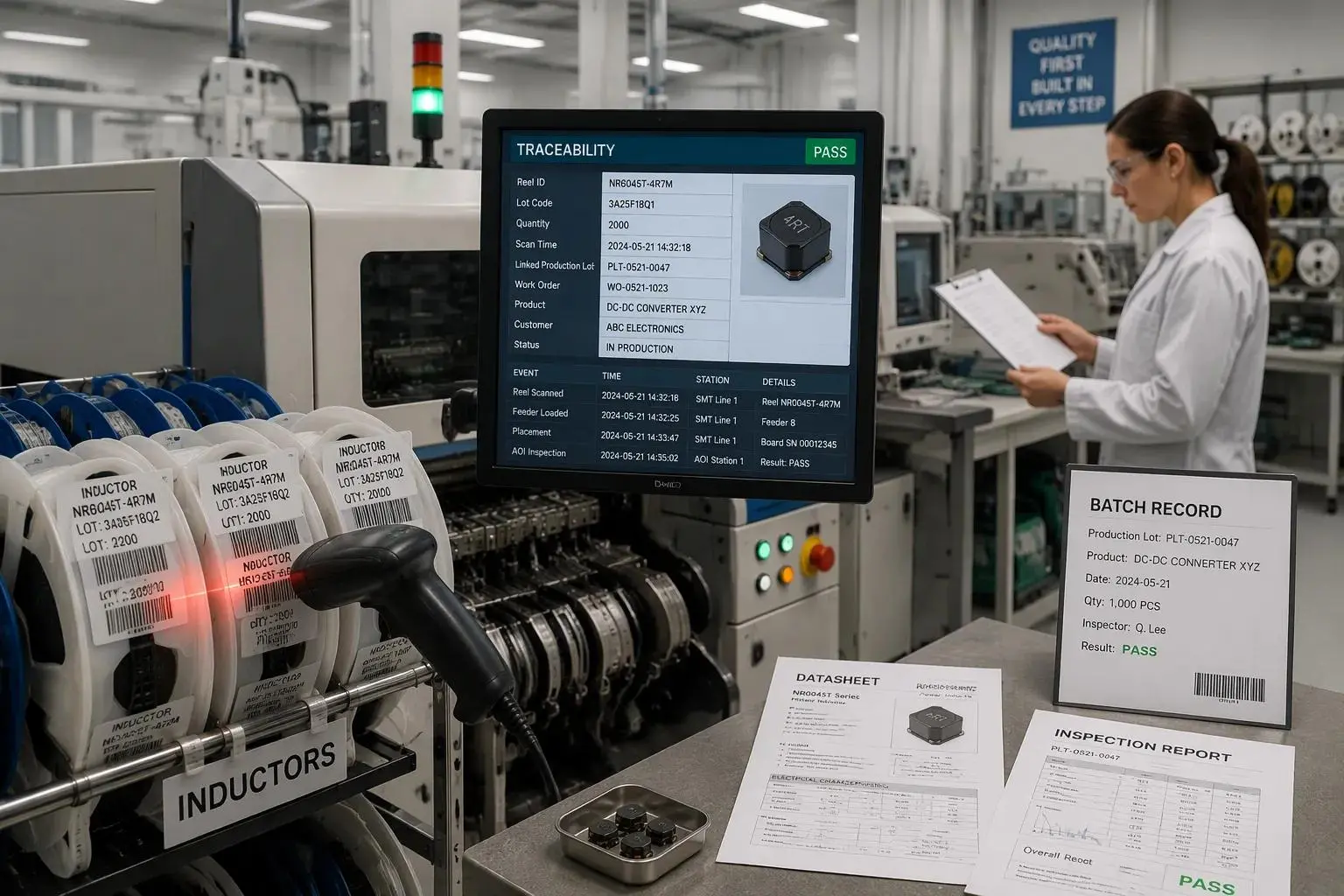
IATF 16949 compliance requires strict traceability controls and end-to-end documentation of every production step. Automotive inductor traceability starts with the lot and reaches down to the individual unit. This discipline separates automotive electronics programs from commercial ones.
Lot-Level and Unit-Level Tracking
Mandatory lot traceability begins with a unique lot code assigned at the raw material stage. That code follows the wound core, the assembly, and the test operation. Reel-level traceability extends the thread to the packaging step, so a customer can identify the exact reel shipped against a purchase order. Feeder-level reel traceability closes the loop on the line: a placement machine reads the reel identity, and the assembly record then links every placed inductor to its source reel. This end-to-end bidirectional traceability lets a manufacturer move from a field return back to a production lot, or forward from a suspect lot to every affected assembly.
Part-level tracking limits recalls. A defect confined to one lot stays confined, because the record links parts to process data. Customers gain trust when they can request a sample batch record and receive it while they wait. The record should name the lot, the date code, the inspection result, and the functional outcome, as PCBasic notes in its supplier audit guidance. Vertically integrated manufacturing supports complete end-to-end quality control and full traceability, because one organization owns every step from winding to final test. That ownership removes the handoff gaps where records break down.
Documentation and Data Retention
Documentation and data retention turn automotive inductor traceability into proof. CoilMX advises keeping the selected datasheet revision, electrical comparison, footprint review, sample test results, and any customer-specific qualification records with the project. For controlled supply programs, buyers should confirm ordering information and change-notification expectations with the supplier. Suppliers of AEC-Q200 qualified inductors typically support PPAP documentation, traceability, and project-specific reliability or validation requirements under IATF 16949.
IATF 16949 adds automotive-specific requirements on top of that foundation, which is why most Tier 1 and Tier 2 automotive programs require it specifically rather than accepting ISO 9001 alone.
Samtec illustrates the standard in practice: its automotive A-Series products are manufactured in a controlled IATF 16949 facility, built to Samtec drawings and standards, registered in the International Material Data System, and supported by Level 3 Production Part Approval Process packages. The record that carries weight logs one nonconformance: what went wrong, when it was raised, what fix was applied, and who signed it off. Auditors should ask for that record from a real lot. A rejected lot, a rework, or a supplier change should each leave a dated entry with an owner's name. End-to-end traceability records tie that evidence to one batch, starting before a single part is placed, with approved-source purchasing, sourcing documentation review, and risk-based incoming inspection linked to the order. A batch identifier then pulls material, process, and test onto one thread. The fields worth having include BOM revision, batch number, process route, and quality-control entries that name what was checked at each step, from first-article result to functional-test outcome, written into a manufacturing execution system. Automotive electronics programs depend on this discipline, and the linked records should be retrievable for a named batch.
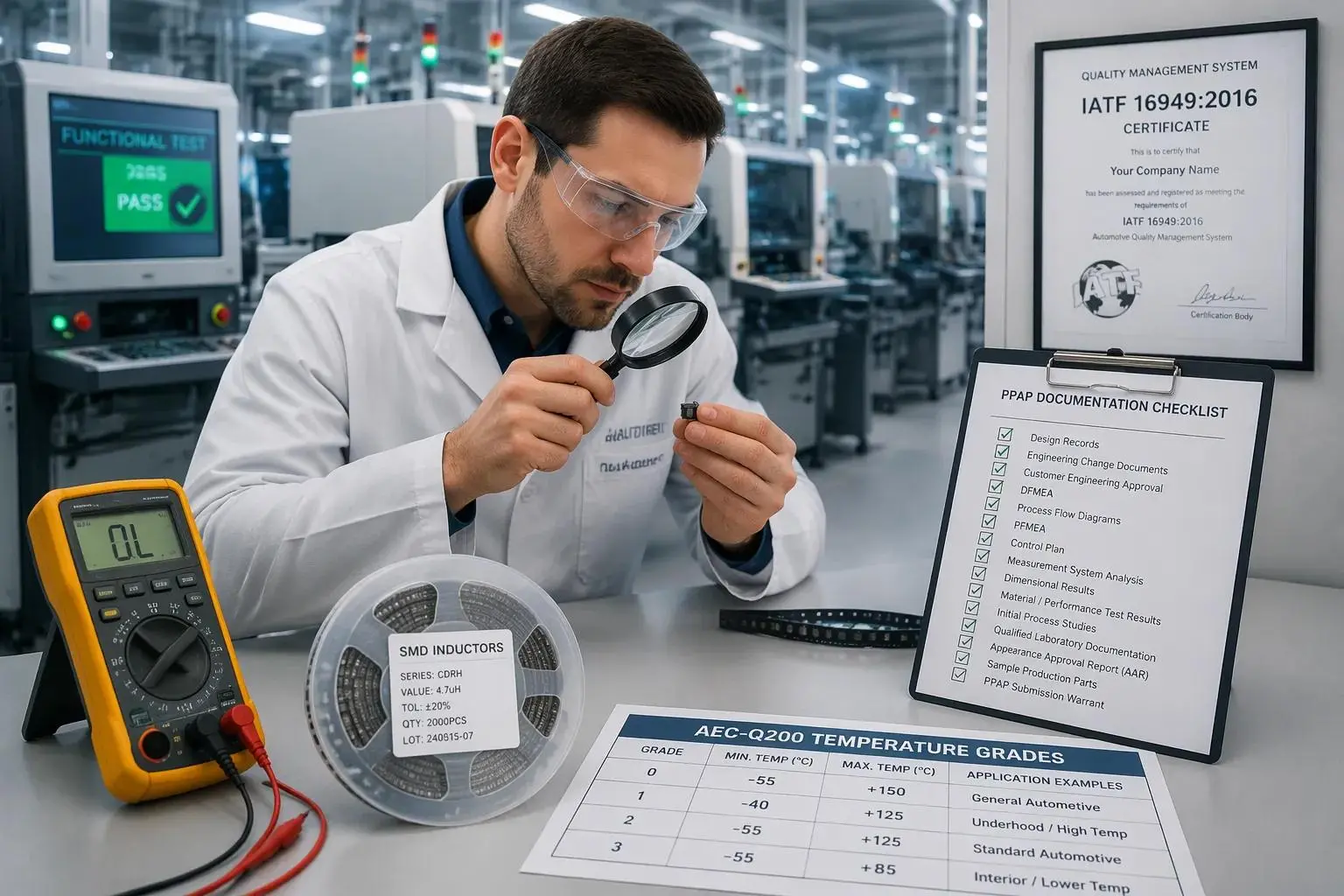
Production quality in automotive dc-dc converter inductor design rests on two pillars: a compliant quality management system and a qualified part. Both must hold before a single reel ships.
IATF 16949 Compliance
The field failure target is zero parts per million. These targets drive every process decision in automotive dc-dc converter inductor design.
Process design must account for reliability and stability. Key processes require a CPK of at least 1.67, a capability level that leaves measurable margin between the specification limit and the process spread. A process running below that threshold cannot demonstrate the stability automotive electronics programs demand.
IATF 16949 compliance also requires Advanced Product Quality Planning (APQP). Suppliers submit PPAP documentation that includes design records, process flow diagrams, FMEA, control plans, and capability studies. APQP and PPAP approval is the formal gateway to becoming an approved supplier. Suppliers of automotive-certified magnetics support PPAP documentation plus project-specific reliability or validation requirements.
AEC-Q200 Standard Qualification
The AEC-Q200 standard sets qualification by grade. Panasonic documents the temperature ranges as follows.
Grade | Temperature Range |
Grade 0 | -50°C to +150°C (most severe, all mounting locations) |
Grade 1 | -40°C to +125°C (high-temperature areas such as the engine compartment) |
Grade 2 | -40°C to +105°C (some passenger-cabin areas) |
Grade 3 | -40°C to +85°C (general passenger-compartment use) |
Grade 4 | 0°C to +70°C (outside automotive electrical scope) |
Test conditions differ by grade even for the same test item. Major tests require statistically justified sample sizes, such as n = 77.
AEC-Q200 contains 28 test items in total, but magnetic devices face a narrower set. Table 5 of AEC-Q200 Rev E lists the applicable tests for inductors and transformers, per Codaca:
1. Pre- and post-stress electrical test
2. High temperature exposure (storage)
3. Temperature cycling
4. Humidity bias
5. High temperature operating life
6. External visual
7. Physical dimensions
8. Terminal strength (leaded)
9. Resistance to solvents
10. Mechanical shock
11. Vibration
12. Resistance to soldering heat
13. ESD (human body model)
14. Solderability
15. Electrical characterization
16. Flammability
17. Board flex (SMD)
18. Terminal strength (SMD)
Some tests do not apply. Resistance to solvents covers ink-marked parts, not laser-marked ones. ESD testing is not required for inductive components. Flammability mainly targets exposed resin or plastic, and metallic cores with copper wire do not need it, per Codaca.
Representative samples undergo physical dimension checks against the datasheet, visual inspection of construction and marking, and electrical measurement before and after stress. Sourcing AEC-Q200 components means confirming the grade matches the mounting location. AEC-Q200 component sourcing also means verifying the test list covers the part family. Power inductor selection for a hot engine-bay location demands Grade 1 or better. Inductor selection for a cabin circuit may accept Grade 3. Saturation current must hold across the rated temperature range, not just at 25°C.
Automotive power electronics teams treat these checks as part of automotive dc-dc converter inductor design, not as a final gate. Automotive electronics programs that embed them early avoid late redesigns. The quality record then reflects a part built to standard, not a part tested into compliance.
Process Controls and Testing
In-Process Inspection
Process controls catch deviation before it reaches the customer. Automotive electronics programs build inspection into each production step, not at the end of the line. Winding tension, core placement, and solder joint formation each carry a defined check. Operators record the result against the lot code in real time.
Statistical process control anchors these checks. Key processes must hold a CPK of at least 1.67, so the control chart flags drift while margin still exists. A trend toward the specification limit triggers a corrective action before any out-of-spec unit ships. This discipline protects the zero-defect target that automotive dc-dc converter inductor design demands.
Final Test and Validation
Final test confirms that each inductor meets its electrical specification. Test stations measure inductance, DC resistance, saturation behavior, and insulation resistance. The station writes results to the unit record and links them to the lot. A failed unit never leaves the floor without a documented disposition.
Validation then proves the design against the AEC-Q200 test list. Samples undergo temperature cycling, humidity bias, high temperature operating life, vibration, mechanical shock, and board flex. Electrical measurements run before and after each stress. A part that drifts outside its tolerance band fails qualification, regardless of its initial reading.
AEC-Q200 requires statistically justified sample sizes for major tests, so validation rests on evidence rather than a handful of units.
Automotive electronics teams treat final test and validation as one loop. Test data feeds back into automotive dc-dc converter inductor design, and the loop tightens with each build. Inductor selection then rests on proven capability, not on a datasheet claim. That feedback also strengthens long-term reliability, because every drift becomes a process correction rather than a field return. The quality record closes only when test, validation, and lot data agree.
Traceability's Role in Quality and Compliance
Traceability documents every production step, and that record demonstrates compliance for industries with strict standards such as automotive. Manufacturers certified to IATF 16949, ISO 9001, and AEC-Q200 meet global standards for quality and traceability.
Linking Test Data to Production Lots
Test data carries weight only when it ties to a specific lot. Yiyang Magnets tests every inductor for inductance, DC resistance, and saturation current before shipment, and each production lot remains traceable. The supplier can then provide material declarations, test reports, and certificates of conformance on request.
Reliability Focus | Assurance | Benefit |
100% electrical testing | Every inductor tested for L, DCR, and Isat before shipment | Guarantees each part meets ordered specifications |
Thermal and mechanical durability | Temperature cycling, thermal shock, and vibration tests per IEC 60068 | Ensures long-term reliability in real-world conditions |
RoHS and REACH compliance | All materials comply with both regulations | Simplifies compliance for global markets |
AEC-Q200 qualification | Select series qualified to the stress test standard | Suits EV charging systems and ECUs |
Traceability and documentation | Each lot traceable; declarations and reports available | Supports ISO 9001 systems and supply-chain audits |
Chipsen Electronics Technology runs MES-based management of production scheduling, material traceability, process parameters, and real-time quality data. Its automated testing covers inductance, resistance, dielectric strength, turns ratio, and polarity with traceable data. MES records then support lot-level investigation.
Supporting Audits and Corrective Actions
Audits reward evidence, not assurances. Chipsen maintains lot and date-code traceability, recorded electrical-test results where agreed, nonconformance containment and corrective-action records, and engineering-change review with customer notification. Smartsolenoid describes a similar system: traceability of materials, production batches, process parameters, and inspection and test records. That structure makes rapid root cause analysis and corrective action practical.
End-to-end traceability also protects the approved state over the product lifecycle. Change control keeps the qualified design intact, and automotive electronics compliance rests on that continuity. For automotive electronics programs, the payoff is a quality record that answers an auditor's question with a dated entry and a named owner.
Best Practices for Implementation
Building a Traceability Data System
A workable data system starts with a unique identifier at the raw material stage. That identifier follows the wound core through assembly, test, and packaging. Each production step writes its result against the same record. The system then answers two questions quickly: where did this unit come from, and where did this lot go.
Manufacturers should treat mes & traceability as one platform, not two projects. Chipsen Electronics Technology runs MES-based management of scheduling, material traceability, process parameters, and real-time quality data. That single source removes the handoff gaps where paper records break down. Digital traceability also shortens investigation time, because an engineer can pull a batch record without walking the floor.
Integrating Traceability into Process Control
Traceability delivers value when it feeds the control loop. A control chart flags drift on a key process, and the lot record shows which units ran during that window. The team then quarantines the affected units before shipment. This link protects the zero-defect target that automotive electronics programs demand.
Integration also strengthens corrective action. A field return carries a lot code, and the record names the process route, the inspection results, and the operator sign-off. Engineers can trace a defect to its source step and correct the process rather than the part. Every inductor then ships with evidence behind it, and quality rests on recorded proof rather than assurance.
Automotive programs demand lot- and unit-level tracking, documented retention, IATF 16949 compliance, AEC-Q200 qualification, and disciplined process controls and testing. Automotive inductor traceability ties these requirements together. It underpins quality assurance, limits recalls to a single lot, and proves compliance during audits.
Each inductor should carry a record from raw material to final test. Automotive electronics teams that build this record into production gain faster investigations and stronger corrective actions.
The forward-looking view is simple. Traceability works best as part of the process, not an add-on. Teams that integrate it early ship every part with evidence behind it.